


- This event has passed.
Justice in Progress: A Step Toward Accountability and Healing for Shakahola Victims’ Families
January 22
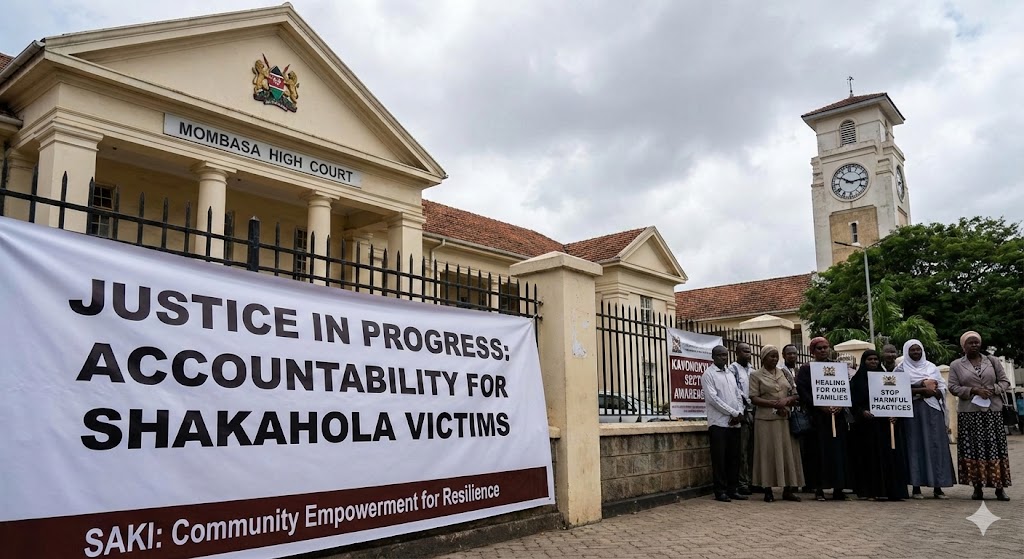
In a significant development in one of Kenya’s most harrowing criminal cases, the Shakahola massacre trial has witnessed a major breakthrough that brings hope for justice to hundreds of grieving families. Enos Amanya commonly known as Halleluja, and who is one of 29 accused persons in the Shakahola killings, has pleaded guilty to 191 counts of murder before Lady Justice Diana Kavedza in Mombasa High Court, bringing to an end 22 months of denial and trial. This dramatic change of plea marks a critical milestone in the pursuit of accountability for the mass deaths linked to the Shakahola tragedy that occurred between January 2021 and September 2023.
The case has exposed the distressing impact of manipulation and abuse on vulnerable communities. Among the massacre victims were numerous children. In a particularly heartbreaking revelation, Amanya confessed to witnessing the deaths of his own children and participating in their burial alongside his wife. Ironically, his wife remains among the accused persons still maintaining her innocence. Only one of their children survived after rejecting the sect’s teachings and leaving Shakahola to seek employment.
Court proceedings revealed a coordinated scheme orchestrated by self-styled preacher Paul Nthenge Mackenzie, who acted as the chief architect of the operation. The prosecution detailed how the sect employed a deliberate system of starvation, abuse, and coercion to control followers.
Central to the sect’s operations was a coded language designed to normalize death within the community. Bodies were simply referred to as “fertilizer,” burials termed as “planting,” and dying described as “taking a jet” to meet Jesus. Followers reportedly shouted “Amina” to affirm Mackenzie’s instructions, creating an environment of absolute obedience where dissent was met with brutal punishment with some would be dissenters being tied with binding wire and beaten until death. This systematic abuse highlights the vulnerability of communities when critical thinking is suppressed and absolute obedience is demanded.
The prosecution has effectively closed its case after calling 120 witnesses and producing more than 500 exhibits over six months of intensive hearings. Justice Diana Kavedza convicted Amanya on his own guilty plea with the Director of Public Prosecutions calling for a comprehensive victim impact assessment report to guide sentencing, with particular consideration for surviving family members
At SAKI, we recognize that this case underscores the critical importance of community education, awareness, and empowerment to protect vulnerable populations. The tragedy reminds us why community-driven initiatives matters. When communities are actively engaged, informed, and economically empowered, they become more resilient against exploitation.
While no verdict can restore what was lost, this breakthrough in the legal process represents an important step toward accountability. Justice for the Shakahola victims and their families requires not only legal proceedings and convictions but also collective commitment to building communities where such tragedies cannot take root.
This case of Christian extremism is not an isolated incident in Kenya. The country has previously experienced similar cases, though none have reached the scale and horror of the Shakahola massacre.
Among adherents of the Kavonokya sect, prominent in the Eastern Kenya counties of Kitui, Embu, Meru, and Tharaka Nithi, cases of children dying from treatable diseases and pregnant women dying during childbirth due to lack of medical attention have been recorded. Their faith prohibits seeking conventional medical care, leading to preventable deaths. In one particularly bizarre case, a pregnant woman reportedly underwent a caesarean section at the hands of church elders rather than trained medical professionals.
These recurring incidents underscore the urgent need for community awareness, education, and protective measures to safeguard vulnerable populations from harmful religious practices that endanger lives, particularly those of women and children.
SAKI remains committed to working with local leaders, organizations, and communities to create environments where dignity is upheld, critical thinking is encouraged, and every individual has the opportunity to thrive.
As we await the final sentencing, we stand in solidarity with the victims’ families and recommit ourselves to the work of building stronger, more resilient communities throughout Kenya.
For more information about SAKI’s community empowerment programs or to support our work in education, economic development, and youth engagement, please contact us directly.